


Ask Away: GM 10-Bolt vs. 12-Bolt Rear-Ends

With the upcoming addition of the 454-cubic-inch big block to my 1966 El Camino, I begin to worry about the durability of the 8.2-inch 10-bolt rear. It currently houses a 3.36:1 gear ratio which I am very happy with. The car itself is a driver, I do not drag race, nor do I anticipate ever taking it to the track to do so although I plan to do more than a few aggressive accelerations on occasion. But for the most part, the car isn’t going to be abused beyond the occasional tire fry. I run 255/50’s on the rear.
The present 8.2 is an open diff, so with the big block it isn’t going to ever hook hard enough to break anything, however I would like to upgrade the rear end to a posi at some point and that’s where the concern begins. Can the 8.2 be modified to be survivable behind a big block that may occasionally hook?
If I reuse the existing gears, it looks like I’ll have about $900 in parts and I expect I’ll spend another $400 in labor to install. This probably isn’t all that different a cost if I applied the same upgrade to a rebuildable 12-bolt, but finding a 12-bolt today is not nearly as easy as it used to be. So the question is, will an upgraded 8.2-inch 10-bolt be reliable behind a street big block that isn’t raced?
E.R.
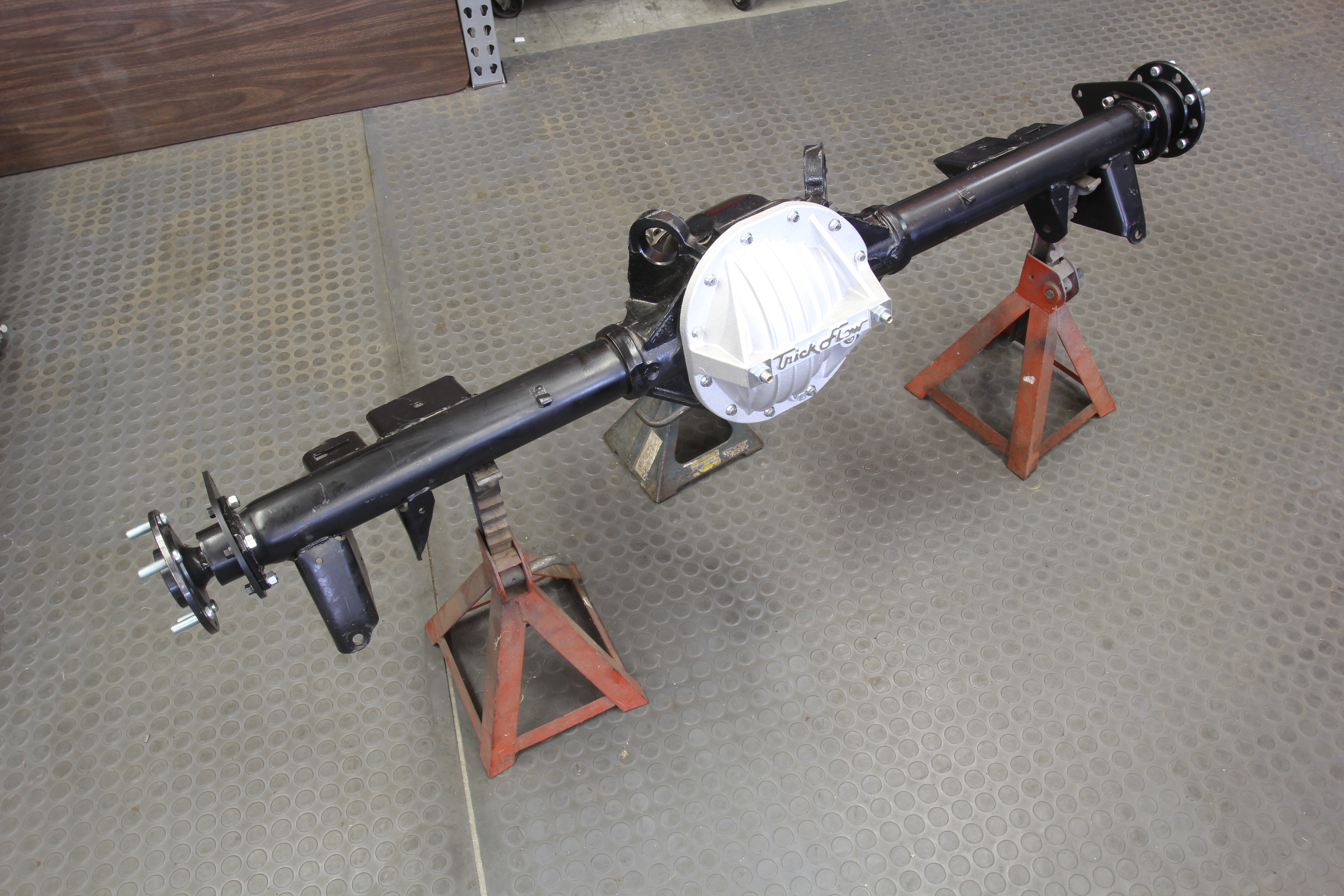 Jeff Smith: The essence of car building and hot rodding has always been discovering the weak link in the powertrain chain. This is really a great question and not one that is really easily answered. Rear-end strength is generally measured in terms of torque capacity. But the real issue is traction. An El Camino generally is lighter over the rear tires than a Chevelle, so traction is more difficult to achieve. As long as your tires never completely hook when the power is applied from a dead start, such as at the drag strip, a weaker rear axle like the 8.2-inch 10-bolt will likely survive. That’s the short answer. But if you’ve been reading this column for any time at all, you know we like to get into the details to deliver reliable tech information. So let’s dig a little deeper into this question and see what we come up with.
First, let’s compare the 8.2 10-bolt to the 8.875-inch 12-bolt. These dimensions refer to the ring gear diameters (the 8.2 dimension is really 8.125) and as you might expect, the larger the ring gear, the better tooth contact between the ring and pinion. But there are far more important areas of concern. First, the 10-bolt’s pinion shaft diameter is 1.438 (25 splines) while the 12-bolt is 1.625 (30 splines) which makes the 12-bolt 13 percent larger in diameter and therefore stronger. But it’s rare to see pinion shafts twist. The weak point is actually out at the axle splines. The 8.2 uses a 28-spline axle (1.20 inches in diameter) while the 12-bolt uses a 30-spline axle (1.625 inches in diameter).
The main reason the axles often fail first can be traced to what happens when engine torque is applied to the tires. Let’s take a typical 454 big block Chevy like yours. Even a decent Rat motor with a mild torque converter can produce 330 to 350 ft.-lbs. of torque at 3,000 rpm. Let’s use that as our converter flash point. Torque converters can multiply torque anywhere from 1.8:1 to 2.5:1 times the input torque at stall, which means with 2:1 torque multiplication at 330 ft.-lbs., at that moment the transmission input shaft sees 660 ft.-lbs. of torque. Then multiply that times the first gear ratio (we’ll assume a TH-400) at 2.48:1 (we’ll also assume no efficiency loss just to keep the math simple) which gives us 1,637 ft.-lbs. of torque at the driveshaft. Now multiply that times the rear-end ratio of 3.31:1 which means the differential is experiencing a maximum of 5,418 ft.-lbs. of twisting motion. Split that number in half to put equal torque to both tires and each axle shaft could be subjected to over 2,700 ft.-lbs. of torque. Of course, this assumes perfect traction. This can easily happen, which is why the axle splines could twist or fail since they are the first in line to experience that torque. While an additional two teeth on the splines hardly seems enough, it goes a long way to improving durability.
One way to improve the strength of the 10-bolt would be to upgrade to 30-spline axles, but right now there isn’t a bolt-in way to do this, so you are stuck with using the strongest 28-spline axle you can find. Companies like Moser, as you found, offer a 1541H alloy steel induction-hardened axle that is quite a bit stronger than the production 1040 carbon steel axles. New axles also will require new bearings, seals, and axle studs as well. I’d suggest a Ratech installation kit. I’ve used their kits in several applications with great success.
I created a list of the major components including reusing your existing 3.36:1 gears. The total comes to just over $1,000 plus approximately $400 for installation labor at a professional shop. That’s roughly $1,400—a big-dollar expenditure for a 10-bolt. However, you make a good point about buying a used 12-bolt housing that we’ll assume will need to be completely rebuilt including new gears and a posi. With that scenario you’re looking at a used 12-bolt for around $600 to $800 and then investing another $1,400 or more to bring it back to life. But then you would have a new rear axle housing that you know without a doubt will handle any abuse you can dish out. My estimate is that the combination of a set of 255/50R17 street tires on the back of your El Camino will not present sufficient traction—even with a set of sticky Mickey Thompson ET Street tires that grip really well. I think if you drive the El Camino sanely, with the knowledge that it is just a 10-bolt, it will hold up just fine.
8.2 Rear Axle Component List
| Component | Part Number | Price |
| Yukon Dura-Grip posi | YDGGM8.2-3-28-1 | $482.13 |
| Moser axles, pr. | A102802 | $259.97 |
| Moser wheel studs, 7/16 | 8060 | $17.50 |
| Ratech gear install kit | 3020K | $111.97 |
| Summit Racing diff cover | SME-8510300 | $149.97 |

Why not install a 14-bolt? Strength will never be an issue and the extra weight will help the rear end gain traction.
Get a 9 inch Ford by Curry , easy to get ,affordable and reliable for your big block .
i would look for a 8,5 10 bolts that is cheaper but almost as strong as a 12 bolts
YOU ARE 100 PERCENT RIGHT DON !!!!!! ONLY THE SMART FOLKS IN THE WORLD KNOW ABOUT THE 8.5 BUICK AXLE
I had a 10 bolt posi in a 72 Monte Carlo with a 300 hp 350 and broke the pinion shaft showing off after a turn.
Use the 12 bolt!!!!
The 8.2 10 bolt is great little rear end, I have a 1970 Chevy Nova that runs 11’s through the quarter with a 1:56 60′ time. I run a stock open differential with a Richmond mini spool, Richmond 4:11 gears, and Moser street axles. I have in the last 10 year of racing only had to replace the Ring and Pinion twice (which can expected with drag racing)
Hi Jeff, It All sounds Good as the man said fitt the Ford.I have a 27000 cc Rolls Royce merlin Engine in a Street Legal Motor car.I run Run elevans.With JAGUAR Rear end.But I want to Run Nines and stil be street Legal.So in goes that Ford. Just go on U tube typ in john dodd beast sit back and enjoy. It all makes the X files Look like blue Peater.
I also have an El Camino, a 1969 model with a BBC. The unit in mine is also a 10 bolt open. I was thinking for the price, I would just go with the 9″ Ford assembly when I get the 4L80E rebuilt. Seems as though I can do the used housing and the whole inside setup brand new for about $2500. even.
Is a gm 10 Bolt or a gm 12 bolt better
Was it possible for the 1970 Big Block 396(402) Nova come with the 10 Bolt Rear-end installed from the factory? I know the 12 bolt was optional for around $150 from the dealer at the time but $150 was a lot of money to the car buyer in 1970. Did the factory turn out some 10 bolt rear ends in the big block Nova’s from 1970?
I got a 12 bolt posi carrier but its in a Buick 10 bolt housing from like an 83 Electra. Will I be able to swap the carrier into my 12 Buick housing in my 72 Riviera?
I run a 8.5″ 10 bolt on a car that runs in the 11’s. So far haven’t any problems with it. it does have, Richmond gears, Eaton carrier, and a T/A performance girdle.
I’m pretty sure the transmission and differential DIVIDE torque. Taking the 660 lb.ft multiplied by the torque converter, you ÷2.48, than ÷3.36, than ÷2, which comes to a grand total of 39.6lb.ft per wheel.
They had it right in the article. 39.6 lb. ft. would barely move the vehicle.
Even the 8.5 is not strong enough
I lost 3 of then even with after market parts
Then got a 9 inch. Problem solved