


EFI 101: 3 Reasons to Consider a Self-Learning Fuel Injection System

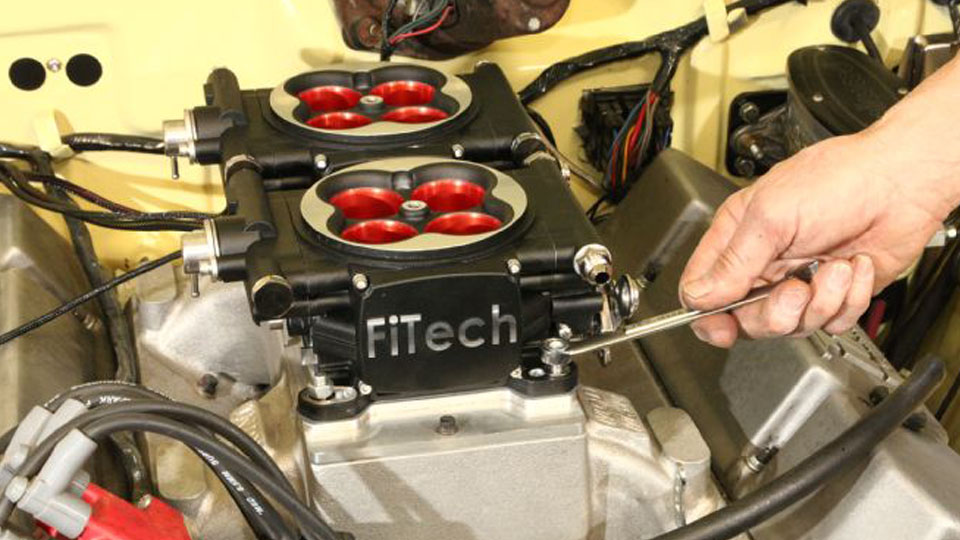
Tuning is rewarding when you want to do it, but aggravating when you have to do it. Today’s self-learning fuel injection systems give us the best of both worlds. The injection units quickly learn what the engine wants to run at its best and offers additional tools for those who like to tinker.
Three things had to happen for injection to replace carbs:
- Easier and faster tuning than a carburetor.
- Pricing rivaling carburetors.
- Simplified installation and lowered cost by maximizing use of existing ignition and fuel system components.
Tuning
Fuel injection at its core offers excellent fuel atomization at all temperatures, elevations and loads. Injection is unaffected by running angle, vapor lock, or fuel slosh. No longer does hard braking, extreme climb angles, or hard acceleration pull liquid fuel away from jets and complex emulsion orifices.
From better atomization, we see a variety of benefits.
- Better fuel efficiency and lower emissions.
- Better combustion which increases power.
- A cooler, denser air charge.
- Better mixture distribution to all cylinders.
- Better idle stability when running a big cam.
- Less raw gasoline smell from exhaust due to a better burn.
- Longer engine life from reduced fuel wash on cylinder walls.
- Fewer spark plug changes.
Manufacturers have provided a great initial setup as EFI units provide a good state of tune right out of the box. Answering a few simple questions such as displacement, rpm, and cam timing determines its basemap. This basemap is an estimation of an engine’s volumetric efficiency and how much fuel must be delivered from idle to redline, and from no load to fully loaded (0-100 kPa and higher, if supercharged).
As the O2 sensor is heated and the engine is coming up to temperature while running, the ECU begins to correct the estimated values in the cells with the engine’s actual V.E. The more time the engine spends at a given load and rpm, the more often its trim is updated.
Pricing
If you need a simple carburetor replacement for a 400-horsepower engine, units start under $800. The original ignition system is retained and the only required connection to the EFI is the tach signal.
Units supporting up to 600-800 horsepower can be found between $1,000-$1,250. They offer color touch screens for initial programming. Some models have air/fuel ratio compensation and timing retard for mild boost and wet nitrous. Data logging, multiple fan control and AC idle control are options at this price point. Ignition timing control is possible with a two-wire distributor with a properly phased locked out rotor.
At $1,500, some units are capable of 800+ horsepower and have software featuring comprehensive boost and nitrous control strategies.
Installation
Fuel: Fuel injection units need 45 psi of pressure while others operate at 58. There are several ways to achieve this, including:
- Fit an inline pump. Some EFI units are internally regulated and others require an external return-style regulator. A return line should be run to reduce load on the pump.
- In-tank pumps are more difficult to install, but run quieter and more efficiently as they are pushing fuel rather than pulling it. These also require a return line to be run.
- Install a reservoir tank in your engine bay. These are priced at $400-$600 and contain a high pressure pump and regulator. The tank acts as a float and is fed by the original low pressure mechanical or electric pump. There is no need for a return line.
Wiring: Today’s units are highly self-contained. The ECU, map sensor, inlet air temperature sensor, and idle air control valve are usually integrated in the throttle body.
- Basic wiring harness inputs are power, ground, key-on, tach signal, water temp and O2 sensor.
- Common outputs are electric fan relays and electric fuel pump relay.
- Optional outputs are nitrous solenoid relay, timing control with two-wire distributor, CAN system, and transmission controller.

Which one would be best suited for dual carb set up such as a Max-Wedge engine?
FiTech makes its Go EFI 2×4 625 HP system specifically for most popular dual-quad setups. They also offer a power adder-friendly system for bigger cube engines or Roots superchargers.