


Ask Away! with Jeff Smith: Can I Mix Zinc Additive with Off-the-Shelf Motor Oil to Save Money?

(Image/WK Ford)
Why can’t I just add a bottle of zinc additive to my oil and then just use regular off-the-shelf oil? Won’t that work just as well as those more expensive hot rod oils that have higher zinc levels? GM used to sell an additive called Engine Oil Supplement and we used to add that to new engines for initial start-up and break-in. Isn’t that the same thing? Thanks. – R.B.
…
Jeff Smith: I have been asked this question several times, so it’s worth going into a bit more detail.
Most enthusiasts know by now that back in 1996, the American Petroleum Institute (API) changed the formulation for engine oil by reducing the level of zinc and phosphorous (commonly called ZDDP, which is short for zinc dialkyl dithiophosphate) from levels of around 1,500 parts-per-million (ppm) to what is now 800 ppm with API designation SN.
ZDDP is a high-pressure lubricant that is carefully mixed with engine oil at a specific temperature and at a specific point to maximize its ability to perform its duties in the engine.
Since the 1940s, the formulation of ZDDP has changed several times through the years.
So when you dump in a can of ZDDP from a company claiming to solve the flat tappet camshaft issue—the first thing a petroleum engineer will tell you is that pouring a foreign additive into existing engine oil is not a good idea—regardless of the additive’s intended goal.
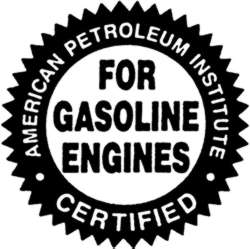
If this API ‘donut’ appears on a bottle of oil, inspect the label as this means the oil is a current spec API legal oil with an SL, SM, or SN rating. This means it contains roughly an 800 ppm concentration of ZDDP and is probably not a good choice for a flat tappet camshaft engine unless the valvetrain is completely stock—and even then this might be taking chances with lifter/cam durability. (Image/American Petroleum Institute)
If you need oil with extra ZDDP, the best procedure is to use oil that already contains the additive mixed in the proper dosage.
Too much ZDDP can do almost as much harm than not enough.
High levels of ZDDP can begin clogging the lubricant-carrying crevices in the cylinder wall, which can then cause the engine to burn oil.
Total Seal’s Keith Jones told us that a few customers who had been using race oil in high-output street engines began to burn oil beyond what they considered normal.
Jones told us his solution was to have the customers try an oil change using a high-detergent diesel oil for roughly 100 to 200 miles. The reason behind this is that detergents tend to strip away ZDDP from the valleys or crevices created in the cylinder wall during the honing process. By removing the excess ZDDP by running a high-detergent oil, the engine’s excess oil use returned to normal. This also illustrates that properly blended performance oils offer a careful balance between detergent levels and ZDDP. Adding ZDDP to the oil changes that careful balance which likely will not produce the desired effect.
Essentially, too much ZDDP can be just as bad as too little.
I took this question to Lake Speed Jr. who is a tribologist (an oil engineer) with Driven Racing Oil and he offered a few more points.
“Mixing an additive into motor oil can cause adverse chemical reactions. ZDDP is acidic in nature and motor oils that contain detergents are basic in nature. As a result, mixing ZDDP into high-detergent oil can cause an acid/base reaction,” Speed Jr. said.
As an example, Speed offered the rather dramatic case of what happens when you mix baking soda and vinegar. If you’ve not witnessed this first-hand, the result is a foaming mess. Mixing ZDDP additive with your oil won’t be as dramatic as this vinegar-soda example, but unless you perform a chemical analysis of the oil after mixing, you really won’t know.
“Motor oils have a blend order that keeps reactive additives in the proper order of addition to prevent adverse chemical reactions,” Speed Jr. said. “By introducing an additive to motor oil, the blend order has been altered, and that increases the chance of an adverse chemical reaction.”
As a follow-up, Speed Jr. said that adding ZDDP alters the oil’s actual chemistry.
“Adding ZDDP to motor oil lowers the base number and reduces the service life of the oil,” he said.
The base number to which Speed Jr. is referring is a rating of the oil’s ability to resist corrosion by neutralizing acids that naturally form as a result of combustion. This is especially troublesome for engines that do not run long enough to exceed 212 degrees F of oil temperature. This is the point where the water (and acid) would boil off as a vapor and are eliminated by the PCV system.
This change in the engine oil’s base number means that well-intentioned amateur chemists “splash-blending” ZDDP with engine oil will likely reduce the oil change interval by making the oil more acidic. We’ve seen engines that have been stored with old, acidic oil. The bearings were terribly damaged with deep corrosion pits. So this is another factor to consider.
As you can see, there are several reasons why adding a ZDDP additive to engine oil is a bad idea.
Frankly, this extends to an additive product of any kind for many of the same reasons. The point to remember is that motor oil is a very complex mix of chemicals that are carefully blended to work together. It’s best not to mess with that success.
So if mixing ZDDP isn’t a suitable option, we’re back to using engine oil specifically intended for flat-tappet performance engines not fitted with catalytic converters.
We won’t include a complete list of all these oils as there are dozens, but we can offer several suggestions.
Among your choices are petroleum-based, synthetic, or synthetic blends. Driven offers an HR2 oil in a 10w30 that is a good place to start.
Other companies offering similar products are Comp Cams’ Muscle Car & Street Rod engine oil, Edelbrock, Lucas Oil, Royal Purple, Red Line, Valvoline’s VR1 racing oil, and many others.
It would be beneficial to do your own research and talk to fellow enthusiasts about specific oils, but be careful because there are lots of opinions out there, but very few verifiable facts.
Rather than opinions, I prefer to go with actual performance data, if you can find it. All of the above companies offer a superior product, so by choosing any of them, you can’t make a bad choice.

By adding diesel oil to a gasoline engine will it not remove the zinc and possibly damage the valve train?
A common thought is to use diesel oil in a gas engine expecially turbo charged ones for extra protection and valvetrain life extension. I would really like to know if this is a false conclusion or not. Also should ZDDP oils NOT be used in engines using catalytic convertors??
I’ve always run Rotella T because it has more ZDDP than others.
Is this not a viable option?
Diesel oil formulation has changed almost as much as gasoline engine oil has and the ZDDP concentration is also lowered so this oil is no longer considered a good idea – plus the detergent percentage has also changed. The diesel oils are really no longer a safe alternative for flat tappet performance engines. The risk vs. return gamble is just not worth it.
I’ve been running Rotella T (CJ4 designation) since the loss of ZDDP. I have always added Lucas ZDDP also with zero problems.