


LM7 5.3L Vortec 5300 Engine Specs: Performance, Bore & Stroke, Cylinder Heads, Cam Specs & More

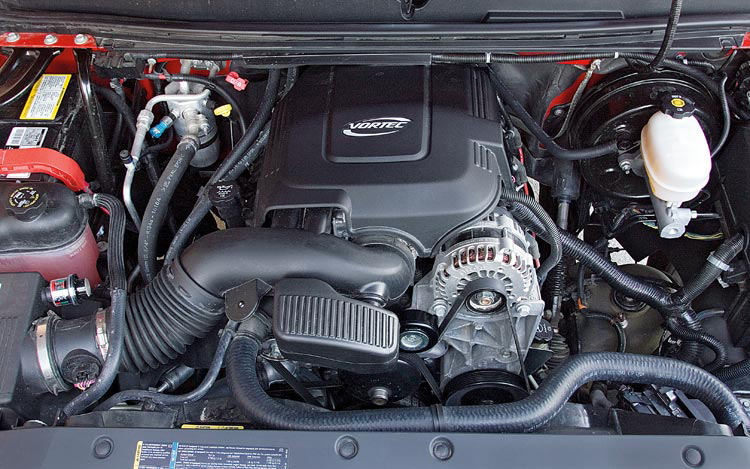
(Image/Motor Trend)
Mechanically similar, General Motors’ LS and LS-based Vortec engines wound up on almost every branch of the GM family tree: Chevy, Pontiac, GMC, Cadillac, Buick—heck, even Saab, Hummer, and Isuzu got some LS love.
Since LS and Vortec engines are so common, they’ve become the go-to performance and swap engines of the modern era.
These motors are capable of making a lot of horsepower, and respond well to upgrades like turbos, superchargers, high-flow cylinder heads, intake systems, cams, and nitrous oxide.
The aftermarket is strong, crate engines are available, and used motors are often cheaply sourced through junkyards.
[Trying to find an LS engine? Check out Part 1 and Part 2 of our LS Spotter’s Guide.]
Summit Racing has created a series of comprehensive guides for each engine in the LS family, so engine builders and tuners can have a handy reference for their projects.
This specific guide is for the Chevy LM7 LS truck engine.
(Summit Racing’s Paul Spurlock and Brian Nutter contributed to this article.)
GM LM7 Engine Specs
The LM7 is a 5.3L, Gen. 3 small block engine used in GM trucks between 1999 and 2007. For marketing purposes, it was also known as the Vortec 5300. The information listed here is for the stock engine.
[table “214” not found /][table “215” not found /]
[table “216” not found /]
[table “217” not found /]
[table “218” not found /]
[table “219” not found /]
[table “220” not found /]
[table “221” not found /]

just want to know what my 2003 lm7 5.3 1500 ls truck horsepower rating is. I think it is 285hp ?
It really depends on your specific vehicle application–but your 285 estimate is certainly right in the ballpark. Our table above says, depending on the vehicle, it’s between 270 and 295 hp.
Hi ,
I am doing a cam delete plate moving the cam sensor to the front and putting in a custom cut zo6 cam with a single bolt cam gear. Unfortunately I ported and polished the 706 cast heads before I learned of their suseptability for cracking. so now i have to re do the 50 hours of hand to head work on the set of 862s i collected. My inquirey has a feew parts to it. 1; will the cam gear mate up with the crank as I want it to with conventional instalation? Ive heard that the two have different amounts of teeth and have been told I need to change the crank. Fingers crossed that I dont. 2; im putting this back into an 02 avalanche. Is it gonna start or will I have to have the ECU reprogramed? 3; Will I need to obtain a stall torque converter, and finally 4;Ive come across a set of H beam rods but there only 6 inch. Will a set of 4.8 flat top pistons make up the difference in lost compression? Any other advice or suggestions are welcome. To be in the know, Ive upgraded the trunions, added a hi flow oil pump, added 3/8 pushrods, added heavier valvesprings, and port matched all the gaskets.
Hi Casper, we’re not quite sure what engine type you’re starting with so we’ll address both.
If you have a Gen. 4 engine, nearly all of them came with 58x reluctors and won’t be compatible with the ECM in a 2002 Avalanche (24X reluctor ring). You are correct that you would need to swap the crank or reluctor itself.
If you have a gen. 4 intake and throttle body, be aware they aren’t wired like the Gen. 3s that were cable driven or used TAC module and different pedal assembly. You may need something like the Torquerush X-Link module to convert, but there’s a chance you could use a straight harness with a 90mm LS2 TB and have it be compatible with your 2002 ECM. Knock sensor extensions would also be required, but some leave them unhooked…which is a little dicey.
Now, Let’s talk about you starting with the LM7 or other Gen. 3 engine. The good news is you already have some pretty good stuff to work with. Definitely check out our LM7 upgrade article for some good tips. Most of the aftermarket cams out there are built on a 3-bolt core, so you can keep the top and bottom timing gears from what you have and just throw a stronger LS2 spec timing chain on it. The rear mount cam sensor is fine, so that saves you a bit of headache. Knock sensor locations too.
The ECM will start and run, but anytime you’re adding horsepower…you will want to have it tuned…there’s big power there anyway. The biggest injectors that came in LM7s came in the 2001-07 versions. At 25 lbs., they support about 380 hp (to the wheels) which may be enough depending on how big you go with the cam.
As for converters, the Stage 1 and Stage 2 Summit Racing Pro LS Truck cams will work with a stock converter. The stage 3 cam would like a 2,500 converter and the Stage 4 would like a 2,800 converter. You can check out those cam specs on the Summit Pro LS Cam article to get an idea of the duration numbers etc. for comparison.
The 6 inch rods you found are probably made for gen. 1 or 2 small block Chevy. The problem is they have an offset in the beam that makes them un-centered under the piston…this causes side loading. Gen. 3/4/5 rods are on-center, so definitely stick with them or aftermarket.
Lastly, flat tops would not help enough to recover the compression of having a piston .100 in. farther down in the cylinder with a short rod.
The 1999-04 LM7 rods used a press fit .9449″ pin vs. the 2005-07 models which switched to the beefier Gen. 4 rods and .9431″ full floating pins. If you aren’t running over a 150 shot of nitrous, one possible combination includes these Scat connecting rods. These are press-fit, stock length rods that would be compatible with Keith Black UEM-2482HC-5MM ( .010 in. overbore) flat top pistons with .9449″ pins. That would get you up to 10.7:1 with the 61cc chambers on the LM7 heads. If you are making more power, then the aftermarket rods are 6.125″ long and have a .927″ pin usually. There are lots of forged pistons available and a flat top version with 2 valve reliefs is pretty easy to find.
The rest of your combination sounds pretty good, but the 3/8″ pushrods are going to require clearancing on the outside of the intake runner. Commonly available .080″ wall 5/16″ like these from Summit Racing are a good choice. Hopefully the information above helps. If we didn’t answer everything, give the folks at Summit Racing a call (330-630-0240) and they can guide you through the process.
I have a stock 5.3L in a 2002 Silverado truck. It has 200,000 on it and I want to build a replacement engine for it. I have built several small blocks over the years but never an LS. I fell in love with this LS and want to build one for this truck with more horsepower but keep it for daily driving. What is your recommendation for Crank, cam, intakes, pistons, rods, and whether to start with a 5.3L or 6.0L ?? I would like to have 350-400 hp.